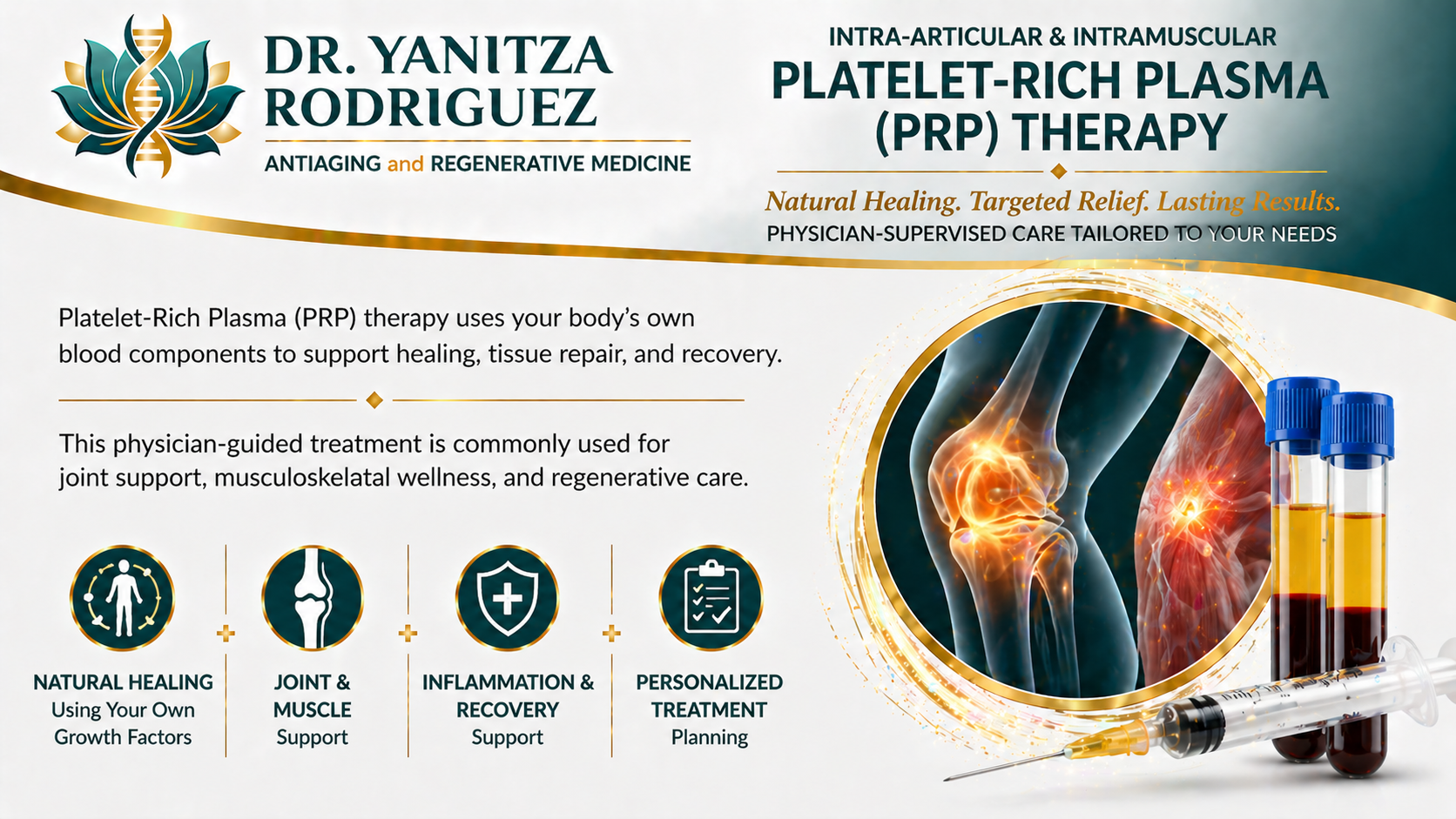
What PRP Regenerative Medicine Is
PRP regenerative medicine uses platelet-rich plasma prepared from your own blood to support healing and tissue recovery. It is commonly discussed in relation to joint support, musculoskeletal wellness, and physician-guided regenerative care plans.
- Natural healing support using your body's own growth factors
- Joint and muscle support
- Inflammation reduction and recovery support
- Personalized treatment planning
What is a PRP injection?
Platelet-rich plasma (PRP) is produced from a person’s own blood. It is a concentration of one type of blood cell (platelets), which is critical for blood clotting. This concentration is injected to an injured or diseased part of a person’s body to accelerate the healing of damaged tendons, ligaments, muscles, bones and joints. A key advantage of PRP injections is that they can reduce the need for opioids, or even over-the-counter anti-inflammatory medications. In fact, use of anti-inflammatories should usually be ceased at the time of PRP treatment, because the platelet-rich plasma optimizes the initial inflammatory response involved with healing.
How do PRP injections work?
The activation of the concentrated platelets in platelet-rich plasma releases growth factors that stimulate and increase the number of reparative cells your body produces. This significantly enhances the body's natural healing process.
Do PRP injections have side effects or risks?
Side effects of PRP injections are very limited because the injections are created from your own blood, and your body should not reject them or react in any negative way. As with any injection, there is a remote risk of infection. Otherwise, there are no significant risks apart from the variability and unpredictability of how effective the treatment will be for a particular patient.
How are PRP injections performed?
PRP injections are prepared by taking anywhere from one to a few tubes of your own blood. It is then run ("spun down") in a centrifuge to separates the blood into its various components: red and white blood cells, plasma, platelets, etc. The platelets are collected and concentrated to anywhere from 2 to 8 times their normal number. The platelets are then mixed into a blood plasma liquid base and injected directly into the area of injury. Ultrasound imaging is sometimes used to guide the injection. The images below show a PRP injection into a patient’s torn tendon